At what distance should your loupes be in focus?
The working distance is measured from the plane of the eyes to the working area. It is the distance at which your loupe optics are focused. The measurement is based on your intended working position.
Whether you are preparing a tooth, performing an endodontic procedure or providing preventive care, you identify the detail you want to see under magnification while in your usual working posture. Your height alone is not enough to determine this. Your seated position, the patient's position and the location of the working area also play a part.
The range in which your optics remain in focus extends around the set working distance. This depth of field allows for small changes in distance. It depends on factors including the optics, lighting and your vision. When trying the loupes, check whether the treatment area is in focus in your intended working position and how much room you have to move while maintaining focus.
Measure rather than estimate
An assumed distance may differ from the distance at which you actually work. Without measurements in your working position, you cannot tell whether the setting matches your working position. You may need to move closer or farther away to bring the image into focus. Measurement in your working position is therefore essential: seated if you treat patients sitting down, and standing if you work on your feet.
Designs for Vision adjusts working distance exclusively in 1.27 cm increments. This is equivalent to half an inch. The appropriate setting is selected with you based on your measured working distance.
After fitting, the focus is checked: is the treatment area sharp in your intended position? Do the optics remain aligned at your working distance?
Interpupillary distance: your view of the working area matters
Your eyes align differently when looking at a near target than when looking into the distance. To position the loupe optics, the functional interpupillary distance is therefore measured: the distance between your pupils when looking at a target at your working distance.
Measurements for the left and right eyes are recorded separately. An estimated total measurement does not reliably capture each eye’s alignment. The interpupillary distance measured for distance vision is also no substitute for measurement at a target at your working distance.
The Engelmann method: each eye individually
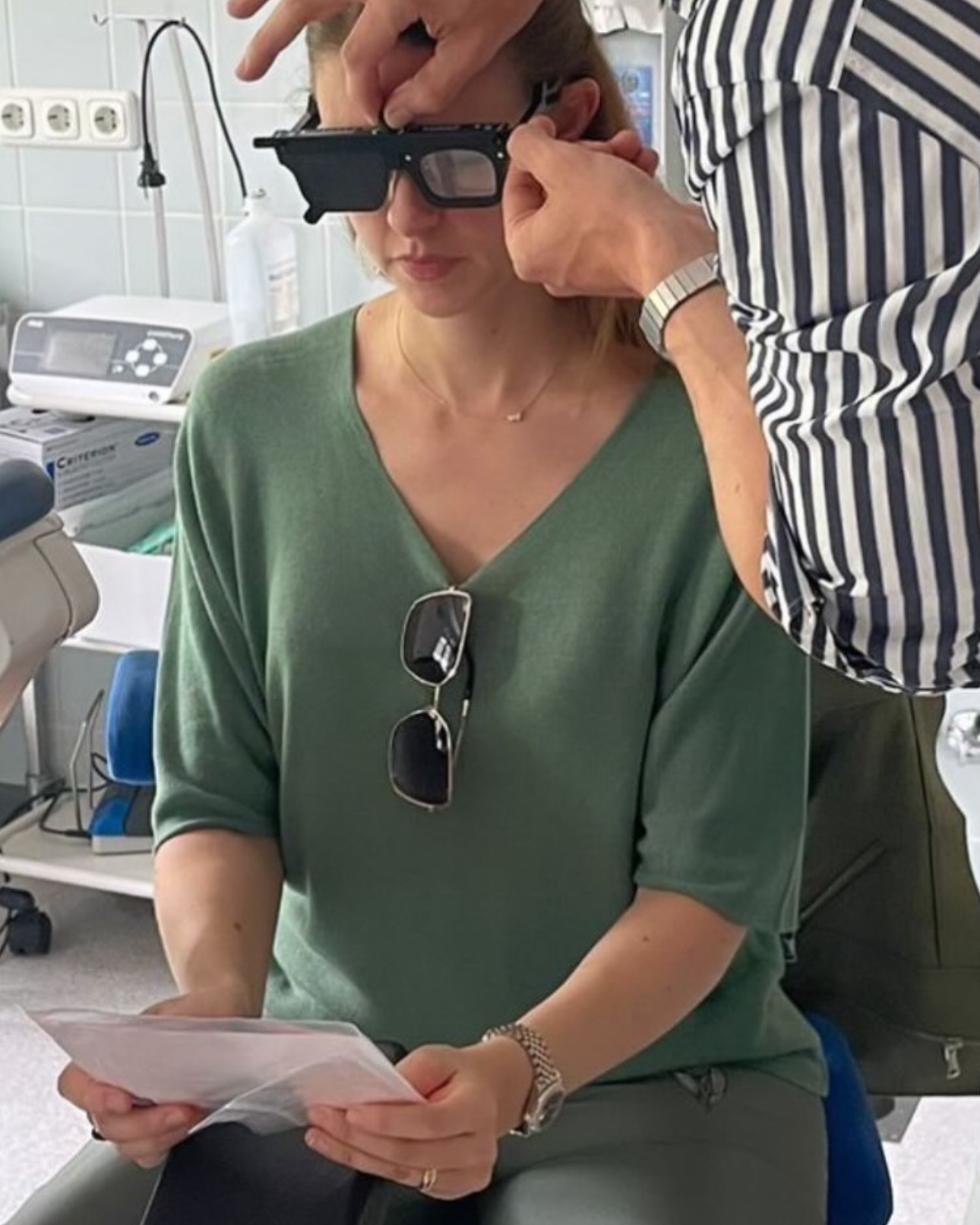
With the Engelmann method, you look at a measurement target at your previously established working distance. One eye is covered while the position for the other eye is determined. The procedure is then repeated on the other side.
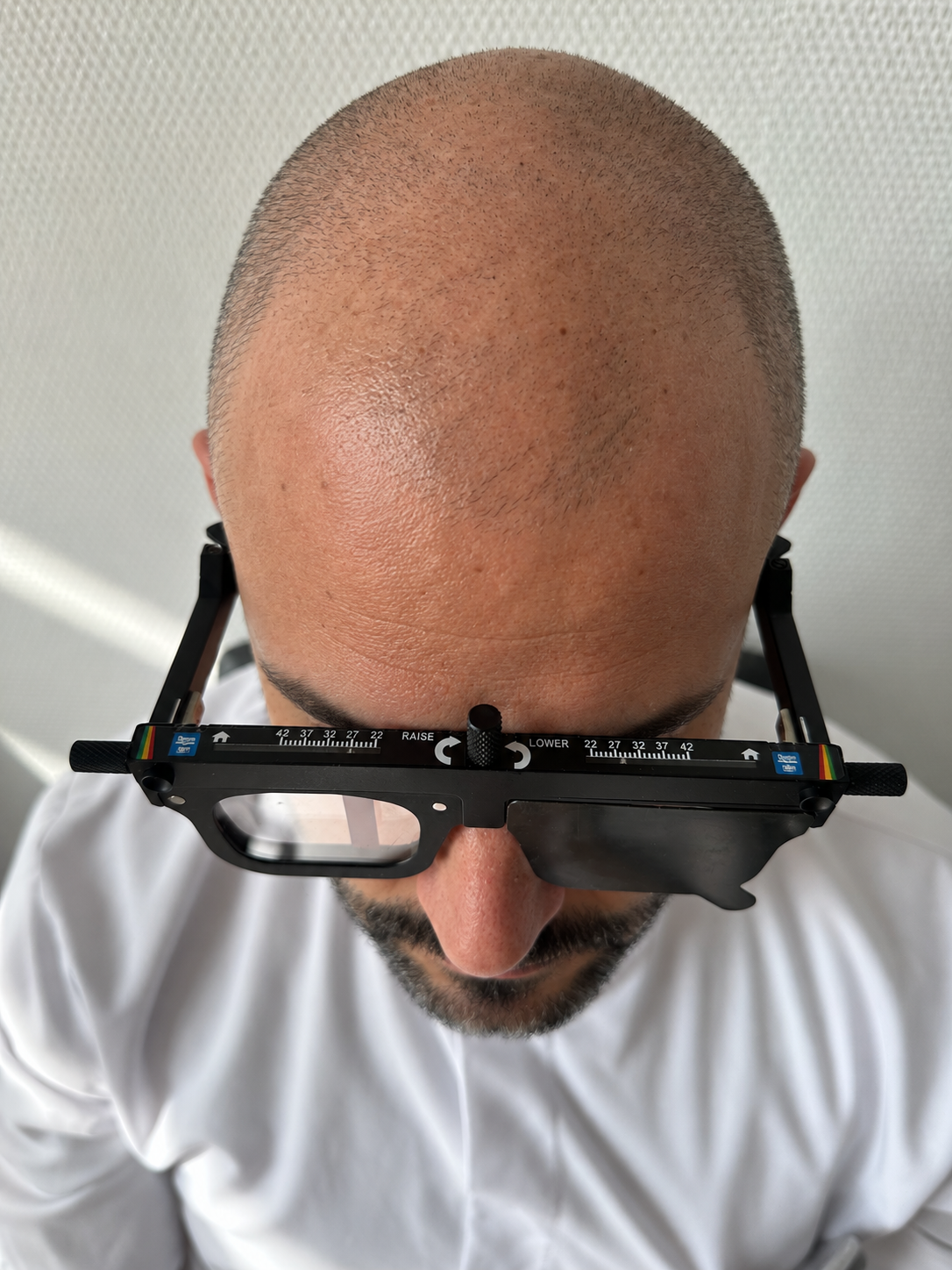
The photograph shows this process with the VerifEYE measuring frame. Measurement is based on your gaze toward the target and is carried out separately for each eye.
What is recorded with the VerifEYE measuring frame
The functional interpupillary distances are read to the nearest 0.5 mm and recorded separately for the left and right eye. The working distance is then measured again and alignment is checked with both eyes open. This also checks whether you have brought the measurement target closer to you during the measurement.
Headaches, dizziness or neck pain?
If you experience discomfort when working with your loupes, it is also worth checking their fit. Optical alignment and your working position are assessed separately.
Headaches and dizziness
If interpupillary distances are only estimated or recorded incorrectly, the optics may be misaligned. Incorrect alignment can strain the eyes and contribute to headaches or dizziness. An unsuitable declination angle can also strain the eyes.
Neck pain
A working distance that is too short may cause you to tilt your head farther forward to see clearly. Sustained poor posture can contribute to neck pain. Working distance and declination angle should therefore be reviewed together.
These symptoms can also have other causes. Dizziness may, for example, occur while you are adapting to new loupe optics. A symptom alone does not prove that there was a measurement error. Persistent symptoms should be assessed by a doctor.
What was actually measured for your loupes?
In addition to working distance and functional interpupillary distance, custom fitting includes the declination angle, frame fit and your existing prescription. The chosen frame must sit in the intended position when worn.
If you would like to understand your previous fitting, these questions may help:
- Was my working distance measured in my actual treatment position?
- Were the functional interpupillary distances measured and recorded for each eye individually?
- Were working distance and alignment checked again with both eyes open?
- Were the declination angle, frame fit and my prescription taken into account?
What has your experience with your loupes been?
Do you have to change your posture to see clearly through your loupes? Or were questions left unanswered at your previous fitting?
Tell us what you notice while working. We would be happy to discuss what should be checked and which loupes suit your clinical tasks.